
Evaluates the date and time values in the YYYY/MM/DD format. You can customize the date/time format according the Date/Time patterns described in this page.
Returns the UNIX time when the search starts. Unlike other functions, this function does not take any argument.
Syntax:
| process eval("identifier=now()")
Example:
| process eval("search_time=now()")
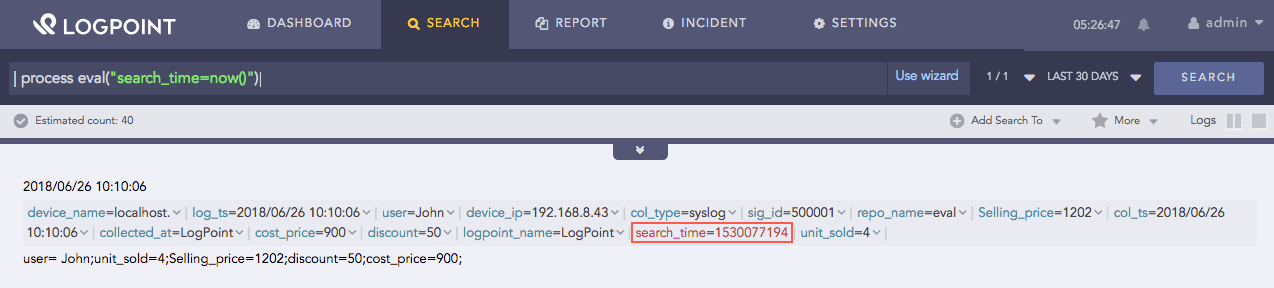
Using now function
Here, the query returns the UNIX time of the search process in the search identifier.
Accepts two arguments: a UNIX time X and a relative time specifier Y as input, and returns a UNIX time by adding or deducting the value of Y from the value of X.
Syntax:
| process eval("identifier=relative_time(X, Y)")
The operator used in Y can be either + or -.
The format specifier of time is s for a second, m for a minute, h for an hour, d for a day and w for a week.
Example:
| process eval("result=relative_time(now(), '+1d')")
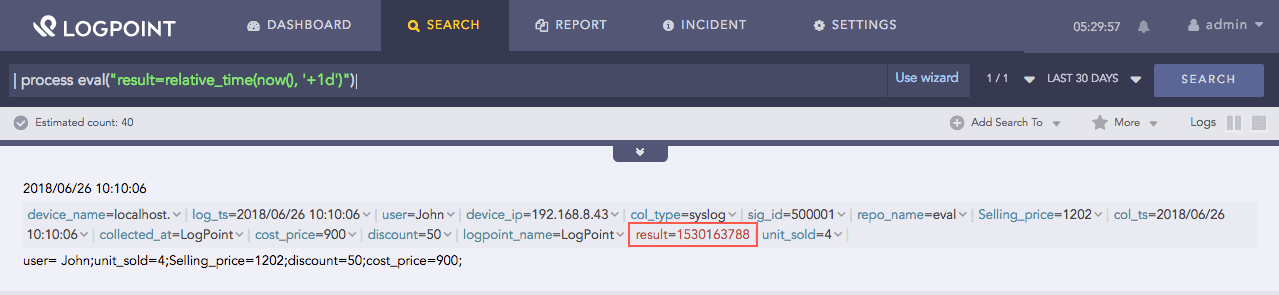
Using relative time function
Here, the query adds time equivalent of 1 day or 24 hours to the current UNIX time and returns it in the result identifier.
Accepts a UNIX time X and returns the time as a string using the date and time format specified in Y. The UNIX time value must be in seconds.
Syntax:
| process eval("identifier=strftime(X, Y)")
Example:
| process eval("day_in_year=strftime(now(), 'DD')")

Using strftime function for day in year
Here, the query accepts the current UNIX time and returns the total number of days in a year in the day_in_year identifier.
Example:
| process eval("search_date=strftime(now(), 'YYYY/MM/dd')")
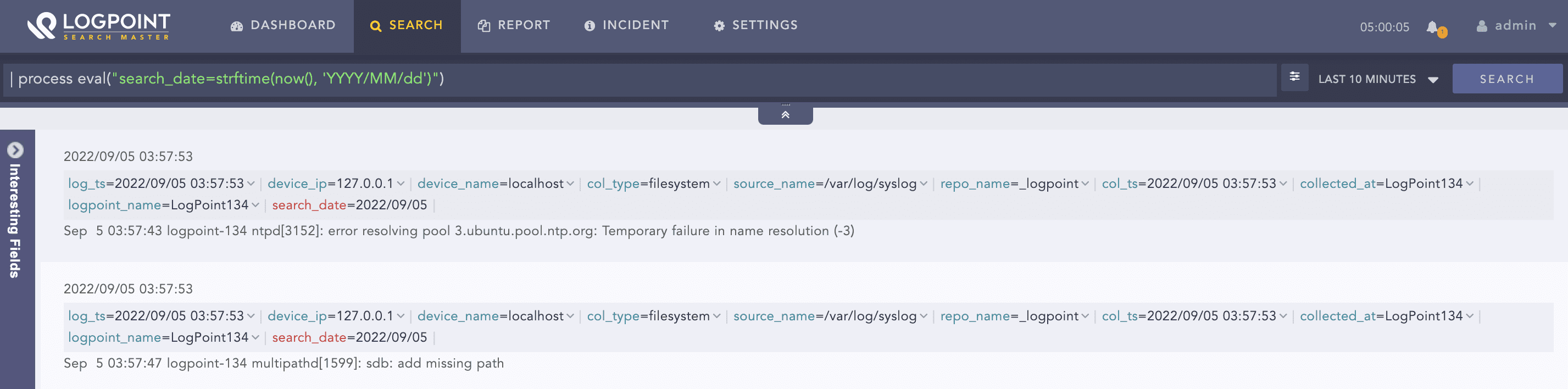
Using strftime function for day in month
Here, the query accepts the current UNIX time and displays the time in YYYY/MM/dd format in the search_date identifier.
The Timezone parameter in the strptime function converts date and time values based on timezone, defined by a fixed offset from Greenwich Mean Time (GMT). By default, the timezone of a machine is used for the conversion. It is an optional parameter.
Syntax:
GMTOffsetTimeZone:
            GMT Sign Hours : Minutes
    Sign: one of
            + -
    Hours:
            Digit
            Digit Digit
    Minutes:
            Digit Digit
    Digit: one of
            0 1 2 3 4 5 6 7 8 9
Example:
| process eval("identifier=strftime(now(), 'yyyy-MM-dd hh:mm:ss', 'GMT+4:45')")
Accepts a human readable time specified in X and converts it into a UNIX timestamp using the date and time format specified in Y.
Syntax:
| process eval("identifier=strptime(X, Y)")
Example:
| process eval("searchtime=strptime('2017-12-12', 'yyyy-mm-dd')")
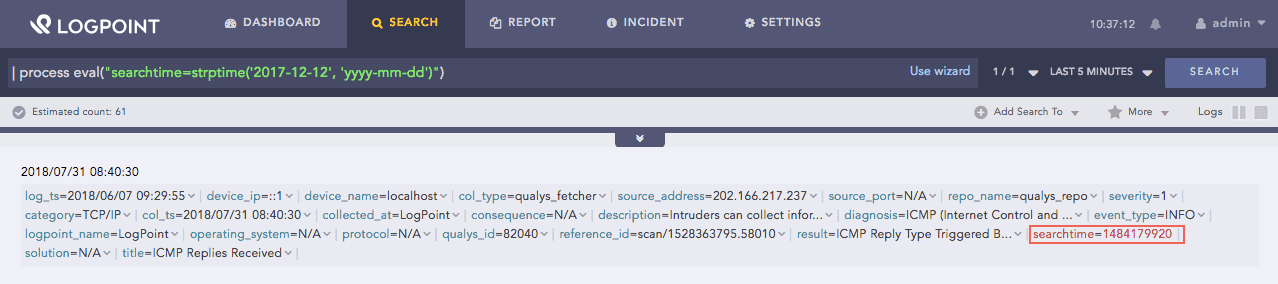
Using strptime function
Here, the query accepts human readable time and converts it to a UNIX timestamp. It returns the converted time in the searchtime identifier.
The Timezone parameter in the strptime function converts date and time values based on timezone, defined by a fixed offset from Greenwich Mean Time (GMT). By default, the timezone of a machine is used for the conversion. It is an optional parameter.
Syntax:
GMTOffsetTimeZone:
            GMT Sign Hours : Minutes
    Sign: one of
            + -
    Hours:
            Digit
            Digit Digit
    Minutes:
            Digit Digit
    Digit: one of
            0 1 2 3 4 5 6 7 8 9
Example:
| process eval("identifier=strptime('2022-08-12', 'yyyy-MM-dd', 'GMT-9:45')")
Takes no argument and returns the UNIX time on which the eval process command processes the command. The returned time is the time when the eval command processed the event.
Syntax:
| process eval("identifier=time()")
Example:
| process eval("process_time=time()")
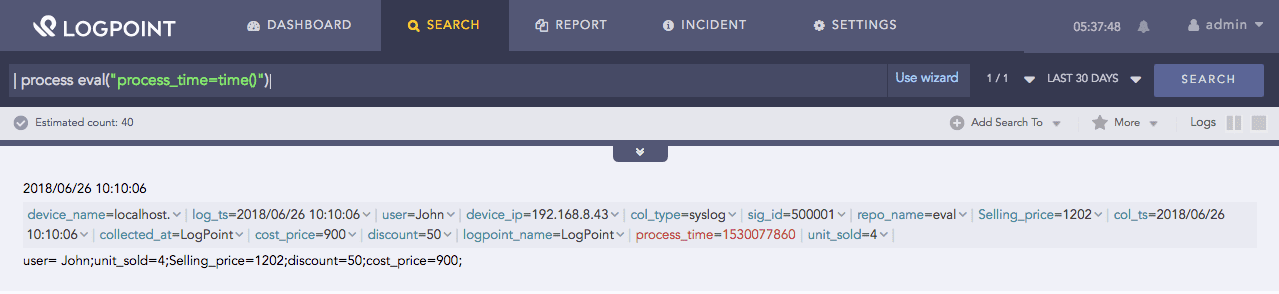
Using time function
Here, the query returns the time of the eval command execution in the process_time identifier.
The list of all possible patterns in the date/time function.
Letter |
Date or Time Component |
Presentation |
Examples |
|---|---|---|---|
G |
Era designator |
Text |
AD |
y |
Year |
Year |
1996; 96 |
Y |
Week year |
Year |
2009; 09 |
M |
Month in year (context sensitive) |
Month |
July; Jul; 07 |
L |
Month in year (standalone form) |
Month |
July; Jul; 07 |
w |
Week in year |
Number |
27 |
W |
Week in month |
Number |
2 |
D |
Day in year |
Number |
189 |
d |
Day in month |
Number |
10 |
F |
Day of week in month |
Number |
2 |
E |
Day name in week |
Text |
Tuesday; Tue |
u |
Day number of week (1 = Monday, …, 7 = Sunday) |
Number |
1 |
a |
Am/pm marker |
Text |
PM |
H |
Hour in day (0-23) |
Number |
0 |
k |
Hour in day (1-24) |
Number |
24 |
K |
Hour in am/pm (0-11) |
Number |
0 |
h |
Hour in am/pm (1-12) |
Number |
12 |
m |
Minute in hour |
Number |
30 |
s |
Second in minute |
Number |
55 |
S |
Millisecond |
Number |
978 |
z |
Time zone |
General time zone |
Pacific Standard Time; PST; GMT-08:00 |
Z |
Time zone |
RFC 822 time zone |
-0800 |
X |
Time zone |
ISO 8601 time zone |
-08; -0800; -08:00 |